
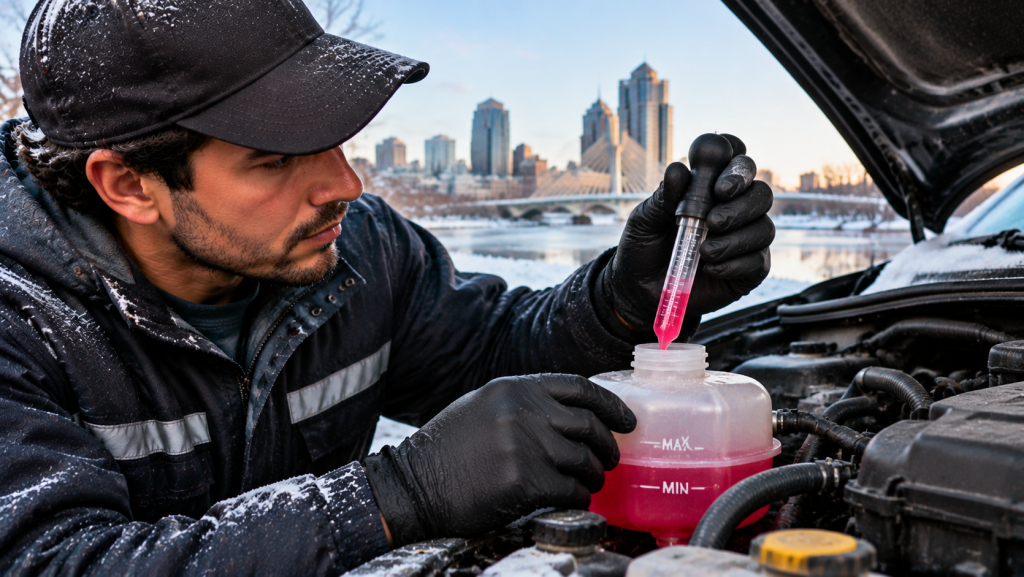
Nebraska winters are not gentle. Temperatures can swing from mild to bitter in a matter of days, and a hard freeze can arrive with little warning. Your car’s cooling system is filled with liquid, and liquid that freezes expands with enough force to crack an engine block, split a radiator or break a hose. The substance that stands between your engine and that damage is antifreeze, also called coolant. It is easy to forget about because it does its work quietly, but it does not last forever, and a coolant that is old, diluted or low can fail exactly when the cold hits. This guide explains what antifreeze does, how the freeze point works, how to check whether your coolant is ready for winter, what can go wrong and how to protect your engine. If you are looking for an antifreeze check in Omaha, here is a plain language overview.
What Antifreeze Does
Coolant has several jobs, and protecting against freezing is only one of them.
- Lowers the freezing point. Plain water freezes at a temperature that is far too warm for a Nebraska winter. Mixed with water, antifreeze keeps the liquid from freezing at much lower temperatures.
- Raises the boiling point. The same mixture handles high temperatures better than water alone, which helps in summer and under heavy load.
- Prevents corrosion. Additives protect metal parts, seals and the water pump from rust and corrosion.
- Lubricates. It helps the water pump and other moving parts.
- Carries heat away. It moves heat from the engine to the radiator, and to the heater core that warms your cabin.
How the Freeze Point Works
The freeze point of your coolant depends on the mix of antifreeze and water. A mixture with too much water freezes at a higher temperature than one with the proper balance. Too little water does not work well either, since a very concentrated mix does not protect as effectively and can reduce heat transfer. Your owner’s manual specifies the type of coolant for your vehicle and the correct mixture, which is why guessing is a bad idea.
Over time, the mixture can change. A leak followed by topping off with plain water, a small leak that lets coolant escape and a long service interval can all leave the system with a weaker blend than you think. That is why checking the actual freeze protection, and not only the level, is worth doing before winter.
How to Check Whether Your Coolant Is Winter Ready
Check the level
With the engine cool, look at the translucent coolant reservoir. It has marks for the minimum and maximum levels. If it is low, there may be a leak, and the system needs inspection. Never open the radiator cap or reservoir cap while the engine is hot, since the system is under pressure and hot coolant can cause serious burns.
Look at the color and condition
- Coolant comes in different colors, including green, orange, pink, yellow and blue, depending on the type. Color alone does not tell you the type, so follow your manual.
- Look for a rusty, muddy, oily or sludgy appearance. These signs mean the coolant is contaminated or worn out.
- Look for floating particles or a film.
Test the freeze protection
A technician can test the freeze point of the coolant with a simple tester, such as a refractometer or hydrometer. The reading shows how low the temperature can go before the mixture begins to freeze, and whether the antifreeze concentration is in the proper range. This is the most reliable way to know that your coolant is ready for winter. Test strips are also sold for drivers, though a technician’s tools are generally more precise. Whatever the method, compare the result to what your vehicle and your climate require.
Check the age and service history
Coolant additives wear out. Your owner’s manual lists a service interval for the coolant, often given in distance and in time. If you do not know when it was last changed, ask a technician to look at it. Our post on preparing your car for Nebraska’s unpredictable weather swings covers other seasonal checks that go along with this one.
What Can Go Wrong With Coolant in Winter
- Too much water. A weak mixture can freeze, which can crack the engine block, radiator or heater core.
- Old or exhausted coolant. Corrosion protection wears out, and rust and deposits build up.
- Leaks. A leaking hose, radiator, water pump or heater core lowers the coolant level, and a low level means less protection and a risk of overheating.
- The wrong type or a bad mix of types. Different coolant chemistries do not always get along, and mixing the wrong ones can cause sludge and damage.
- Frozen or stuck parts. A thermostat stuck closed can cause overheating even in cold weather, and a stuck open one can leave the engine too cool and the heater weak.
- Air in the system. Air pockets can cause overheating and poor heater performance.
Signs Your Cooling System Needs Attention
- Heater blows cool air or takes a long time to warm up.
- Temperature gauge reading higher or lower than usual.
- Coolant puddles under the car. Coolant often has a sweet smell.
- A low coolant level that keeps dropping.
- Steam from under the hood.
- Foggy windows with a sweet smell inside the car, which can mean a heater core leak.
- White exhaust smoke, which in some cases can mean coolant is entering the engine.
- Visible cracks, bulges or crusty residue on hoses and the radiator.
Coolant that gets into the engine can also cause rough running. Our guide to what causes an engine misfire explains the many reasons an engine runs rough, including cooling system problems, so you can see how the pieces fit together.
What to Do If Your Coolant Is Not Ready
- Adjust the mixture. If the level is fine but the freeze protection is weak, a technician may be able to correct the blend.
- Flush and replace old coolant. If the fluid is worn out or dirty, a coolant flush or exchange removes the old fluid and replaces it with fresh coolant of the right type. The details depend on your vehicle.
- Fix leaks first. Adding coolant to a system that leaks only delays the problem.
- Replace worn hoses, the cap or the thermostat if they are weak.
- Follow your owner’s manual for coolant type, mixture and service interval.
Safety Notes
- Never open a hot radiator or coolant cap. Let the engine cool completely first.
- Antifreeze is poisonous. It can taste sweet, which makes it dangerous for children and pets. Wipe up spills right away, store containers closed and out of reach and keep pets away from puddles.
- Do not pour used coolant down a drain or onto the ground. Take it to a recycling or disposal location that accepts it. A technician will usually handle disposal.
- Do not mix coolant types unless your manual allows it.
- Do not drive an overheating engine. Pull over safely, turn off the engine and call for help.
- Wear eye protection and gloves if you handle coolant.
Winter Cooling System Tips
- Check the level regularly, with the engine cool.
- Test the freeze protection before the first hard freeze.
- Watch the temperature gauge, since overheating can happen in winter too.
- Do not use plain water as a long term fix.
- Keep up with the service schedule in your manual.
- Have hoses, belts and the cap inspected for wear.
- Check the heater. If it blows cold, the cause may be low coolant, air or a stuck thermostat.
- Park in a garage when you can, which gives extra protection on the coldest nights.
Can a Mobile Mechanic Check and Service Coolant?
Yes, in most cases. A mobile mechanic can come to your home or workplace in Omaha, check the coolant level and condition, test the freeze protection, inspect hoses and the cap and look for leaks. Many services, such as a coolant flush, hose replacement and thermostat replacement, can be done on site. Larger repairs, such as a radiator replacement on a car with a tight engine bay, a heater core, a water pump or any damage from a frozen system, can take more time or may need a shop. A good technician will tell you honestly what can be done where you are.
Quick Summary
- Antifreeze prevents freezing, raises the boiling point and protects against corrosion.
- The freeze point depends on the mix of coolant and water, and your manual specifies the right type and blend.
- Test the actual freeze protection before winter, in addition to checking the level.
- Old, diluted or leaking coolant is a winter risk.
- Never open a hot cap, and keep antifreeze away from children and pets.
- Many cooling services can be done at your home, and bigger repairs may need a shop.
A coolant check takes little time and can prevent serious winter damage. If you would like help, visit the Mobile Mechanic Pros of Omaha homepage to learn more, or contact us to schedule a visit.